August gave me a better way to develop documents with AI.
Then I had a different problem.
I could see the state of one document, but not the shape of the work around it.
Which pieces were close to ready? Which ones still needed development? Was I putting effort into material for a distant month while an earlier part of the plan remained empty? Had an idea earned a place in the publishing sequence, or was I turning it into a commitment too early?
I wanted a clear view of the months ahead.
I did not want a content calendar telling me to feed the machine.
That tension became March.
A plan is not a promise
I want to publish with some continuity.
I also do not want my personal site to become a production target.
When I use a traditional content calendar, every visible date can start to feel like a commitment. Empty space begins to look like failure. A perfectly filled calendar can become a very tidy way to produce work I do not believe in.
March treats the plan differently.
It gives me a runway: a view of what may be published over the coming months and the state of each piece.
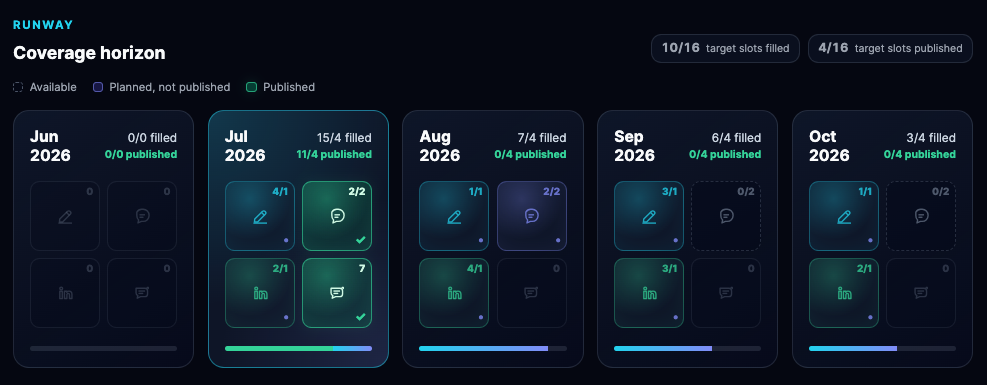
Something can be only an idea. It can be in development, ready, or already published. A planned month gives the work context without granting permission to publish it.
The distinction is simple, but it protects the quality of the work from the appearance of the plan.
The document and the plan have different jobs
August knows the document.
It contains the current text, the versions, the review, and the questions that still need an answer.
March knows where that work may fit.
A planned item can point back to its document in August, but the two services do not need to become the same application.
That keeps two questions separate:
-
Is the document ready?
-
Does it have a place in the publishing plan?
The answers do not always move together.
A document may be ready while its planned month is still far away. Another may occupy the next available slot while still requiring substantial work. An early idea may be valuable without deserving a publication commitment yet.
Seeing those differences helps me decide what deserves attention without asking either tool to make the editorial decision for me.
March is a dashboard, not the planner
March does not decide what I should publish.
It exposes the state of the runway clearly enough that I can plan with AI.
In fact, March exposes an interface for AI agents through MCP, a protocol that gives them access to specific tools and data exposed by the service. Today, I can ask ChatGPT, Claude, or another agent to inspect the months, available publishing slots, intentional gaps, planned pieces, and links back to August.
An agent can surface a gap, compare possible sequences, or propose moving an item earlier or later.
I make the planning decision.
I may know that two topics are too similar to publish close together. I may want to leave space for something that has not happened yet. A draft may need time even when moving it forward would make the runway look healthier.
March keeps the facts visible. I can use AI to question the arrangement and explore alternatives, but the priorities and final decision remain mine.
The shared state remains visible, so neither I nor the AI has to reconstruct the plan from memory. That does not make March self-maintaining: the plan remains useful only if decisions and changes return to it.
Changing the plan can begin as a conversation
Before March, changing direction meant mentally rebuilding the sequence or maintaining another document that would become stale.
Now an agent and I can inspect the same runway, discuss what changed, and arrive at a different arrangement. Once I decide, the agent can update March, and the next conversation starts from that new state.
The useful part is not that AI rearranges a calendar for me. It is that the planning conversation no longer disappears when the chat ends.
That matters because the plan should respond to the work.
An article may take longer than expected. A new idea may become more relevant. A planned piece may stop feeling worth publishing. Something ready may remain deliberately parked.
Changing the plan is part of keeping it honest.
Empty space is part of the game
An empty slot is not an instruction to create something quickly.
It tells me that a part of the future runway is thin. I may develop an existing idea, do more research, change the expected cadence, or leave the space empty.
A filled slot also carries information. It gives a piece a possible place and may bring it into focus before work planned further away.
March makes both states visible without deciding what happens next.
There is also a light game-like quality to it.
The months form a runway. Progress is visible. Moving a piece toward readiness feels satisfying, and watching the plan take shape makes me more likely to return to it.
I like that.
It can also become a trap. If I start creating articles because March looks hungry, I have rebuilt the content machine with a nicer dashboard.
Empty space has to remain a valid state. The game should make progress visible, not manufacture pressure to publish.
August helped me collaborate with AI on the work itself. March gives that work a possible place in the plan.
The test is whether I can still look at an empty month and leave it alone.